Wednesday, May 21, 2014

how to get more greens into your diet


if you're like me, you have good intentions to get those greens in. that is... until your precious head hits the pillow & you realize you haven't even touched one leafy green. here are a handful of tips to get more greens into your diet. enjoy!


1. prep greens ahead of time. i am often in-between tasks when eating lunch. having pre-washed greens on hand makes me more likely to grab the greens instead of last night's dinner leftovers. my husband or i will usually harvest greens once or twice a week from the garden. we soak the greens in water, strain them, chop them, add them to a reusable container with a lid, & place them in the fridge for easy lunch and dinner prep.

2. mason jar salads. my girlfriend & i were just talking about mason jar salads. they're cute & make lunches-on-the-go fun! they're also easy to prep. here's a fun tutorial on making your mason jar salad. simply add the dressing on the bottom & then layer. 

3. freeze your greens. thicker greens, such as kale & spinach, freeze well. simply wash & chop your greens. add them to cookie sheet & freeze. once your greens are completely frozen, remove them from the cookie sheet & add them to a labeled baggie. frozen greens are perfect in hearty soups!


4. add additional greens to recipes. i love experimenting in the kitchen. even if you're a recipe follower, adding additional vegetables, such as yummy greens, to a meal can make it extra delicious and healthy. i love chopping up wilty greens & adding them to my pasta sauce. 

5. green smoothies. green smoothies are a great option for a healthy breakfast or lunch. my favorite smoothie recipe - 1/2 can of coconut milk, 1 banana, 1 tablespoon almond butter, 1/2 cup frozen mango, 1/2 cup frozen greens (kale is my favorite!), & 1/2 cup frozen strawberries. add & blend until smooth. enjoy in a mason jar with a fun straw!

6. weekly challenges. weekly challenges to change habits are a great way to stay mindful. try a weekly challenge of eating a side salad with your dinner every night for one week. ask the family to join in or a group of friends. it's fun & you're one step closer to a healthier habit!

- natalie

Tuesday, May 20, 2014

maine

Perhaps I should call this post- Plants I love that won't grow for me- I have just gotten back from a week in Portland, Maine, and I'm always so interested in the gardens in other parts of the country, and how they differ from my own garden. I have been watching friends' photographs of forsythia, tulips, and daffodils popping up in New England- none of which bloom at the same time for me.  Forsythia begins in February in Memphis, then the daffs come (and usually go) in March, and the tulips shine in April.  Having all three at once, followed so quickly by the budding lilacs, boggles my mind! 


I have always loved the gorgeous cheerful blue forget me nots, but I've never gotten a good start on them.  There are more than 200 species in the genus myosotis, but none of them are particularly happy in the South.  I was just smitten by them.

Alchemilla has always been one of my favorite plants for the shade garden.  It grew well in Winston Salem (zone 7a), in the cottage kitchen and herb gardens of Old Salem, but I have personally killed six of these plants.  They wilt in our summer heat and humidity.  This little plant was up at Two Lights in Cape Elizabeth.  

As you know from my last post, I am crazy about roses. Mine usually begin showing new growth in late February or early March, depending on the severity of our winter.  This rugosa rose, which grows on the beaches, is just beginning to wake up.  There are some rugosa roses that will grow in the South, but I have only ever seen one cultivated, and that was not in Memphis.  I know they prefer really good drainage and sandy soil, which is not something we have here.


Bleeding Heart (dicentra spectabilis) is another plant that prefers cool temperatures and moisture that is not accompanied by scorching heat.  When my mother lived in a heavily forested area in the NC piedmont region (zone 7a) , she grew this, but it was short-lived.  It typically bloomed in early April for her.

All of my ferns are and have been fully leafed out since early April.  The fiddleheads were just popping up in Portland.  These particular fiddleheads were up at Morse Mountain.  I'm not sure what variety of fern this is, but I did indulge in a meal of fiddleheads (the immature ostrich fern) and saw many signs advertising them on the way up to Morse Mountain from Portland, and they were plentiful at both groceries and farmers markets.  I *almost* prefer looking at them to eating them- their flavor was similar to asparagus but had a hint of fish and nut, and I understand that there is a trick to cooking them. 


I so loved visiting Maine and exploring the gardens, forests, and beaches.    And I brought home one small bit of flora tucked in my bag to enjoy as I reacclimate to early summer in Memphis:


Monday, May 19, 2014

Favorite Fillers

Today I wanted to share 4 of my favorite plants to use as gap fillers in my garden.


My absolute favorite gap fillers are hostas.  I just love how their big, lush green foliage fills in around their neighboring plants.  They come in a variety of solid and variegated greens.  Some are flowering while others simply boast beautiful green foliage.  They're easy to thin, so transplanting and spreading to other areas around the garden helps you receive more bang for your buck.  This year, I've thinned quite a few of my hostas, which makes them look sparse at the moment.  But I know in the coming months, they will fill right in and cover up the gaps that are around them.  They do well in shade, so they work great under larger tress or in areas that don't receive much light.

(Shade loving hosta, lady fern, and solomon's seal.  They were tiny 4 inch transplants a few weeks ago but each have already tripled in size)


(Variegated Hosta growing under a Shoshoni Viburnum)


Another favorite are Shasta Daisies.  They may not typically be used as a "filler" plant, but I appreciate their pretty green foliage and how they tend to mold in open areas around them.  Who knows why, but these guys love my yard.  I've already divided several times a tiny little 4 inch plant that I purchased four years ago.  In early Spring, they are very easy to thin and transplant in new areas.  I've also given many away as gifts.  Although they bloom later in the summer, I enjoy their pretty green foliage this time of year.  They are happiest in full sun, but also do well in part shade.

(Thick Chamomile foliage that grows in full sun on the left, Shasta Daisy foliage in the center)


Chamomile, which is considered a weed in some parts of the world, is another plant that isn't typically thought of as a filler.  In my garden however, I love how their delicate, lace-like leaves spread all over and fill in gaps.  I grow both varieties - Roman (a perennial) and German (a self-seeding annual).  Both varieties spread wherever they want and give pretty little blossoms all summer long.  Some gardeners keep them under control in containers.  Their tiny seeds spread like fire in late summer and they can be considered invasive, but I actually like the way they take over open spaces.  They love full sun, where their foliage gets full and thick.  They'll grow in shade and will still flower, however the foliage won't be as full.  In the cooler spring months here in Seattle, they start of tall, thin and leggy.  But come July and August, these little plants will bulk up in volume.

(Leggy Chamomile in bloom)


My favorite plant to cover lower ground areas is Irish Moss.  I just love the varying tones of green and how it fills in around stones, pavers and bricks.  I wish it grew faster, in my garden this is a slower growing plant and has taken several seasons to fill in just small areas.  Come summer though, I love the tiny white blossoms that shoot out of the compact green foliage and appreciate how much it's grown over the years.


What are some of your favorite plants to use as gap fillers in your garden?  I'd love to hear of any success/ failure stories you may have.


Friday, May 16, 2014

Eggshells in the Garden

over at tend over at tend over at tend over at tend
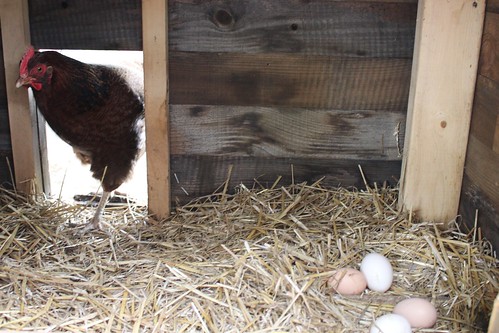
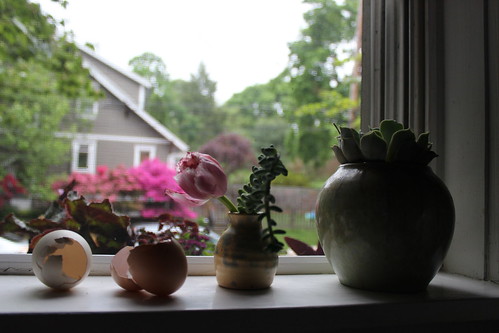
You will always find eggshells drying on my windowsill. They are the "Jack of All Trades" in the garden. And lucky for me my hens provide a steady supply!

Next time you make an omellete set aside those nutrient rich eggshells, which have many uses and can save you money. About 95 percent of shells are made up of calcium carbonate, also present in sea shells, coral, and limestone. The other 5 percent includes proteins, calcium phosphate, and magnesium carbonate.

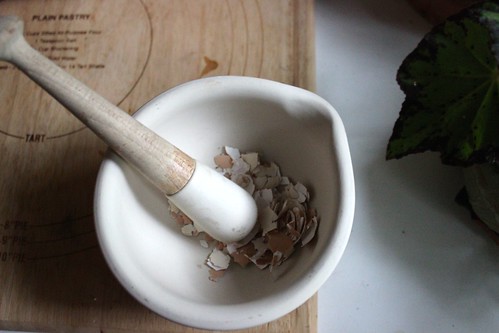
 Always thoroughly wash your shells and allow them to completely dry. Depending on the job egg shells can be applied in crushed or powdered form. Crush them with a mortar and pestle or in a blender or food processor.
 

 ~Add crushed eggshells to the bottom of planting holes, particularly for tomatoes, peppers, and eggplant. These crops are susceptible to blossom end rot, which is caused by calcium deficiency. While this deficiency is most often caused by improper watering, a steady source of calcium is always a plus. As the eggshells break down, they'll nourish the soil, and your plants.

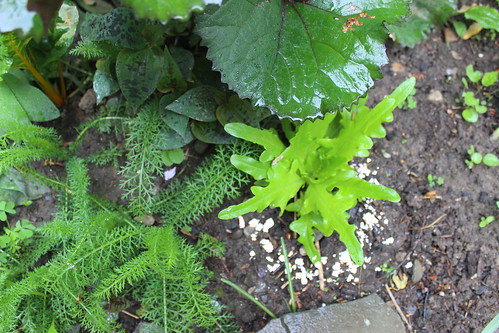
~Use crushed eggshells to deter slugs, snails, and cutworms. The abrasive, sharp edges of the eggshells keep snails and slugs from crossing the shells to get to the plants. I recently made rings around my precious lettuce starts.

 ~Add them to your compost to boost calcium levels in your finished pile.

 ~Rather than using commercial fertilizer, add eggshells to your indoor plants. Add powdered shells directly onto the soil around the base of the plants. Each time you water, the plants will absorb the powder into the soil. This also applies to outdoor potted plants. I plan to add shells to my window boxes this year.

 ~Keep a mason jar of eggshells covered with water for watering potted plants. Or save water from hard boiled eggs to sprinkle plants with this calcium rich tonic.

 ~Hens need plenty of calcium to lay thick-shelled eggs. The best source of calcium for a hen is her own egg shell. Add crushed or powdered egg shells to regular feed to provide a boost of nutrients.

 ~Scattered egg shells can help with cats using your garden as a litter box.

~ If you are feeding birds in your yard, crush up the eggshells and add them to a dish near the feeder. Female birds, particularly those who are getting ready to lay eggs or recently finished laying, require extra calcium.

~Egg shells are also said to keep deer away. Anyone have any luck with this?


Thursday, May 15, 2014

Plants as gifts


My husband, Dan, has been enjoying saffron in his rice lately. I thought I could surprise him so I ordered him some bulbs as a gift  ( from Turkey ! ). They are the same family as crocuses but bloom in the Fall. It was a gift for no reason-- just as a surprise, better when it is not expected.
We did plant them, it is (apparently) really easy to grow.. It is a beautiful purple flower, we will obviously enjoy its taste as well.
I like to give plants as gifts it makes it special seeing it coming back every year different, bigger, stronger.  You need to tend for the plants like any relationship. I feel plants, and trees can be a part of the family and the home.  They tell a story.
For my mother’s birthday this year I got her an ancient fragrant rose bush it was also for the birth of her first grand daughter named Chloe Rose.  Even far away in France she has the presence of her granddaughter.
Do you give plants to your friends and family?


This week we can enjoy the columbine in bloom.


The peach tree by the chicken coop is doing really well.


The sage is in bloom.


On the front porch the wisteria is about to pop!


And the seeds I planted last week are all coming up. I have a couple extra zucchini ( round ones ) Anyone interested ? Our home is in Philadelphia ( fishtown ).

Wednesday, May 14, 2014

our favorite tomato varieties and tomato spacing trick


this weekend we planted tomatoes. 48 tomato plants to be exact. hello, canned tomato sauce & salsa! 


we planted four varieties - cherokee purple, sungolds, celebrity and brandywine. those are among our favorites for eating & canning. they also grow well here in the south. what are your favorite tomato varieties?


with a daunting task like an evening of planting tomatoes, a helpful little trick is always nice. 
our garden is on the smaller size so we like to maximize our bounty with precise spacing. my husband came up with a fun idea i thought i'd share with you today.


we planted our tomatoes exactly 2 ft. apart. this allows our homemade tomato cages to fit perfectly while providing enough space for our tomatoes to grow. using a piece of dried bamboo, a tape measurer & pruning shears, we cut a piece of bamboo exactly 2 ft. long. we then used this measuring (bamboo) stick to measure the spacing between each plant. 


 instead of worrying about getting your measuring tape or yard stick out each time you plant, simply place the measuring stick at the base of your tomato plant that has already been planted. at the end of the stick, plant your next tomato. it's easy peasy & a great activity for the youngins in the garden!

happy planting!
- natalie

Tuesday, May 13, 2014

on becoming a rose lover

This winter was exceptionally harsh, even in the South.  The roses seem to have LOVED it, because all of the roses in my garden are absolutely knocked out.  I have mostly antique/old garden roses for their fragrance and ease of care.  When I was in high school we moved into a house that had a huge bed of hybrid tea roses and they required constant care to preform, so I never really liked them.  My introduction to old roses changed that and require only a late winter pruning and deadheading, plus some compost when I think of it.  Here are my glory girls:

This was my first mother's day gift, and my first rose- Graham Thomas.  Gorgeous buttery yellow with a terrific fragrance.  All yellow roses get black spot, but I try my best to ignore it and focus on the protrusion of buttery blossoms.  This will easily grow 10 feet tall if I'd let it.


This rose is the now-ubiquitous Knock Out.  We planted it at our school one year, and the following year it had been trampled to the point that it was a barely-alive throny stick.  I dug it up one day, planted it in my blue folk-art tire planter with a rosemary, and it was off to the races.  Earlier in March, before our late ice storm, it was 5 ft tall.  I cut it back to 2 ft and it's 5 ft tall again and blooming it's silly head off.  Not much fragrance, but it's nice to see right outside my back door.

This rose, which I may have mentioned before, is the Perle d'Or.  It came with my house.  There are two of them, both quite old and tall. It dates back to the 1880s and is said to be a short, 3-4 ft shrub.  I must have climbing varieties because one has grown all the way up to our roofline, through the camellia, and the other is 10 ft tall.  This rose blooms from March to November or even December for me in zone 8, and one flower scents the whole room with an apple-like fragrance.


This small flowered rose is one of the bees' favorite pollen sources.  It is a rampant grower- even though I cut it back to a single 4 ft cane in January, it had scaled the front of our screen porch by April.  The rains drove it down, so it's flopped over, and I'll cut it back after it finished flowering, or it will be 20 ft tall by the end of the season.  The 1" blossoms have no fragrance to speak of, but the bees- honey, bumble, and small natives- flock to it.  I got this from a friend who worked for a small house museum with a kitchen garden.  It is a bit of a thug, but I still like it.
This rose is the pink's screen porch companion.  It grows up the south side of our porch and offers a glorious floribunda display in April and May and then leafy coverage for the porch after its bloom.  Both it and the pink have nice rose hips if I can manage to not trim them back, and I generally find myself needing to.  I call this a "trash rose" because I just can't kill it.  I think that it must have been root stock for another rose that died before we moved to our house.


I have two of these climbing iceberg roses.  They're tall- reaching for the roof.  And of all of my roses, these root the easiest.  I really enjoy these- they have a lemony fragrance and bloom non-stop.  One is in the front yard, one is in the back.

This sweet little rose is a nameless rescue.  And older woman once lived down  the street and was a master gardener who lived alone until she no longer could.  When her children sold her home to someone who was flipping it, I asked the workman who was digging up the entire front yard and depositing the plants on the curb if I could have this rose, because it thrived in full shade.  It grows along our front fence, in the shade of my vitex tree.

Lastly, my most recent rose acquisition: a mutabilis, or butterfly rose.  This one is so interesting- the buds start out coral, almost orange, open to a single seashell pink blossom, then turn deep magenta-pink as they age and lose their petals.  No fragrance to speak of, this china rose wants to ramble and get to be the size of a school bus (hmm), but it is a real eye-catcher.

I really never thought I'd be a rosarian, but it seems that I am!  They are all mixed in with other perennials in the garden, and even in case of the Graham Thomas, in my vegetable bed.  All of the named old roses are available through the excellent Antique Rose Emporium.  I hope you'll give them a shot!